Jens Larsen
Jens Larsen
How To Play Authentic Jazz Blues In 10 Weeks
Make years of progress in less than 3 months with a little-known pro method that teaches you how to nail the sound
'Love the way he combines theory (step by step) with actually playing. He’s a great teacher with a good method.'

Sander Van Der Togt
⭐⭐⭐⭐⭐
Does This Sound Like You?
You are practicing scales and arpeggios, but it doesn’t help your playing
Your solos don’t sound like jazz blues, just correct notes with no feeling
You spend more time trying to find the right YT lesson than practicing
You have wasted days and weeks on shiny scales and tricks
Scales And Theory Couldn’t Teach Me Jazz Blues - But I Found A Better Way
“This is pointless!” I thought, as I sat down to practice. I’d just quit university to study Jazz full-time, but I wasn’t getting anywhere. Everyone told me the answer was more scales, more arpeggios, and more chromatic stuff.
After months of practice, I was playing lots of “correct” notes that sounded nothing like Joe Pass, Wes Montgomery, or George Benson.
Even though I knew scales and arpeggios, I could not get my playing to sound natural. I was stuck with “rules”, but my solos didn’t feel authentic, like real Jazz Blues.
Spending practice time on theory and exercises would never fix this. I needed another approach.
I was heartbroken and about to give up. Jazz Blues, the very music that made me fall in love with Jazz, was out of reach.
Then I went to a Barry Harris masterclass at the Royal Conservatory in The Hague. I sat there with my Strat struggling to keep up, while Barry made even the simplest triad into amazing bebop lines.
His approach wasn’t about “which notes over which chord.” It was about connecting with rhythm, melody, and feel—to make it sound like Jazz.
It was completely different from stacking scales or memorizing licks.
Suddenly, it clicked: start from sounds that already feel like Jazz, then practice connecting them. My solos finally sounded right.
And I wasn’t grinding scales or transcribing solos for weeks. I started with what sounded right and took it further.
It didn’t just transform my playing. This approach has helped thousands of my students get started with Jazz, and it is the perfect way for you to master Jazz Blues,
"Instead of shooting in the dark, I now know what to practice."

Amir Mojarrad
⭐⭐⭐⭐⭐
How This Method Will Finally Teach You To Sound Like Jazz Blues
Playing Jazz Blues comes down to being able to put together phrases that have the right sound. The right type of melody, rhythm, and phrasing.
You don’t need magic talent. That is a myth.
You also don’t need to know all the scales and arpeggios all over the neck in all keys.
And it’s definitely not about just learning licks and exercises
The real secret?
You need a system that shows you not only what you need to be able to play, but also what 99% of online courses leave out: How to turn that into solid Jazz blues solos!
After having taught 1000s of students, I have a method that teaches you those skills so you can play solos with an authentic Jazz Blues sound.
"His approach doesn't bog you down in theory that obscures the use of the material in actual playing. "

Bryon Musante
⭐⭐⭐⭐⭐
How You'll Learn To Play Solos That Sound Like Real Jazz Blues
Here's The Step-by-step Process To Start Playing Real Jazz Blues:
1
Step 1: Foundation
Develop your basic skills with a fast and easy set of exercises.
The exercises that help you build real vocabulary for Jazz Blues.
Connect scales and arpeggios on the neck so you don’t have to skip around without making sense in your solos.
Spend less time practicing and more time playing because you know where to start.
2
Step 2: A Framework For Soloing
Connect the exercises to the music, and develop solo phrases using blueprints that get you the right sound.
Use my blueprints to create your own strong jazz blues licks.
Level up your soloing by practicing exercises directly on the song where you need them.
A step-by-step method for rhythm and phrasing, and melody, not just technique.
3
Step 3: From Solo To Story
Turn your solos into stories by connecting phrases, something people keep listening to because they are curious what happens next.
Methods and exercises for connecting phrases.
Transform your solos from a lot of licks to a cohesive piece of music.
Skip years of trial-and-error practicing on your own by getting feedback on your work.
4
Step 4: Break The Rules & Go Beyond
Develop new sounds wiith phrasing, double stops, and more advanced rhythms.
A method for Jazz Blues concepts that “break the rules” but still sound great
Add excitement with trills and legato techniques
Go beyond single note lines with double stops and pedal notes
'I have improved more by getting just halfway through this course than I have doing any other course, system or whatever.'

Michael Lawrence
⭐⭐⭐⭐⭐
Everything Included In The Jazz Blues Navigator
10 Chapters with in-depth video lessons
Personal feedback on your progress in the course community
Interactive examples that can change tempo and loop sections
Lesson PDFs and GuitarPro files with tabs and standard notation
Downloadable mp3 backing tracks
What Students Say About My Courses
Instead of shooting in the dark, I now know what to practice.
Instead of shooting in the dark, I now know what to practice. I have bought a few courses in the past, but I definitely recommend Jens courses. For the price of a few guitar lessons, you have a road map that can serve you literally for years. Thank you.
Amir Mojarrad
⭐⭐⭐⭐⭐
Just follow the course and practise as Jens tells you. And you will achieve your next level.
Mark H.
⭐⭐⭐⭐⭐
Fantastically Useful Course!
I love Jens' style of teaching, and the format and content of the course is truly fantastic. The cost of this course is an amazing deal.
Jeff Stine
⭐⭐⭐⭐⭐
Excellent in all respects!
Can't say enough great things to do justice to Jens' teaching style and the humility and patience with which he does it. Of course, he's an excellent musician as well, but it's so incredibly rare to find someone who is an accomplished musician but can also teach! Thanks for this most excellent work, Jens.
Arash Janfada
⭐⭐⭐⭐⭐
Clear, concise, focused on playing music
I think I've found the perfect course for me. Clear, concise, focused on playing music, enough theory to understand what's happening, but not so much that it's distracting.
Robin Sarac
⭐⭐⭐⭐⭐
Excellent course!
Excellent course, Jens is a great teacher, he covers the theory, gives exercises and plays examples for the student to follow.
John Cole
⭐⭐⭐⭐⭐
One of the best Jazz Guitar Teachers
Jens is one of the best Jazz Guitar Teachers, and This Course Is A Gem.
Dhruva Lance
⭐⭐⭐⭐⭐
Jens Is A Natural Teacher
Jens is a natural teacher, cutting to the essence of what can be quite complex topics and showing practical way to immediately apply new information and skills to real music. It is very easy to make something complex but very difficult to make something simple and Jens is a star at this. This course is the best investment I've made in a long time. Thanks Jens!
Paul Evanson
⭐⭐⭐⭐⭐
Pure Gold!
Jens has always been a great teacher, but he has elevated his game with this one, with an amazing production that makes it easier and beautiful to immerse in. The content so far is pure gold, as it always is with him, with the benefit of a long experience in his back that shows here. The best jazz guitar teacher I´ve come across.
David Dickinson
⭐⭐⭐⭐⭐
Start Your Jazz Blues Journey!
Learn Jazz Blues in 10 weeks with a method that develops your actual playing.
$99
Regular price – one-time payment
Lifetime access
3 × $39
3 monthly payments of $39
✅ This is for you if:
You’re tired of trying to magically turn scales and arpeggios into jazz solos — and want feedback from someone who gets it.
You want to play stronger phrases and learn how to connect them so your solos tell a story.
You’re getting started with Jazz and want to add Jazz Blues skills to your playing — both for Blues and Jazz standards.
You’re committed to practicing exercises and soloing daily while working through the course.
❌ This is NOT For You If:
You’re looking for a few licks or a quick fix to play Jazz Blues without putting in the work.
You don’t want to learn to improvise over the Jazz Blues form.
You have no experience improvising at all (then my Jazz Guitar Roadmap course is a better place to start).
You don’t have time to practice at least a few hours per week to internalize the material and level up your skills.

30-day Refund Policy
It's important that the course is right for you!
I don't think you should pay for a Jazz guitar course that doesn't work for you. Therefore, if you enroll and you don't improve your comping and what you can do with Jazz chords, I want you to have the option to check it out for 30 days and figure out if it is what you are looking for. If not, you can ask for a refund.
Just send me an email at [email protected]
Frequently Asked Questions
How is the course delivered?
This is an online course with PDF/mp3/guitarpro downloads. As soon as you purchase, you’ll receive an email with the link to log in.
Save it to have the link later
Can I work at my own pace?
Yes, the course is designed with something like a chapter per week in mind, but people are different and life changes so you do not have to follow that. The course is there for you to work with in a tempo that fits you
Are there PDF downloads?
The exercises and example solos are all available as PDF's and GuitarPro files. The course also have mp3 backing tracks to practice with since some of the exercises are on chord progressions.
How long do I have access to the course?
When you join The Jazz Blues Navigator you get lifetime access to all modules and course materials.
This includes:
- 10 Chapters with in-depth video lessons
- Interactive examples that can change tempo and loop sections
- Personal feedback on your progress in the course community
- Foundational exercises for improvising over a Jazz Blues
- Lesson PDFs and GuitarPro files with tabs and standard notation
- Downloadable backing tracks
How do I get feedback?
The course includes a community where you can post videos and tell me what you are working on in the course. I will give you feedback based on your video and what you tell me.
Start Your Jazz Blues Journey!
Learn Jazz Blues in 10 weeks with a method that develops your actual playing.
$99
Regular price – one-time payment
Lifetime access
3 × $39
3 monthly payments of $39
Course curriculum
Chapter 1 - Foundation & Basics
Intro - The Two Goals
Sheet Music and Backing Tracks
The Scale
F7 - Scale Exercise
F7 - Scale In 3rds Ascending
F7 - Scale In 3rds Descending
F7 - Scale In Triads Ascending
F7 - Scale In Triads Descending
F7 - Scale In 7th Chord Arpeggios Ascending
F7 - Scale In 7th Chord Arpeggio Descending
Practicing And Building Flexibility
Jazz Blues Licks
Chords On The F Blues
How To Play The Chords
Limitation Exercises
Two Note Exercise #1
What To Practice
Chapter 2 - Solo Tools & 2-Note Blues
Intro - Form, Phrasing, and a Few More Scales
Sheet Music and Backing Tracks
2-Note Solo
2-Note Strategy Phrasing & Melody
Bb7 Scale
Bb7 Scale in 3rds Ascending
Bb7 Scale in 3rds Descending
Bb7 Scale in Triads Ascending
Bb7 Scale in Triads Descending
Bb7 Scale in Diatonic Arpeggios Ascending
Bb7 Scale in Diatonic Arpeggios Descending
Explaining C Harmonic Minor on Bdim
Bdim - C Harm Minor Scale
C Harm Min - Scale in 3rds Ascending
C Harm Min - Scale in 3rds Descending
C Harm Min - Scale in Triads Ascending
C Harm Min - Scale in Triads Descending
C Harm Min -Scale in Diatonic Arpeggios Ascending
C Harm Min -Scale in Diatonic Arpeggios Descending
3 Rhythms And Learning New Rhythms
Rhythm #1 Solo
Rhythm #2 Solo
Rhythm #3 Solo
Homework
Chapter 3 - Triads & Blues Flow
Intro
Sheet Music and Backing Tracks
Triads On The Form
Triad Blues Solo
Triad Solo And Flow
Secondary Dominants (D7)
D7(b9) Scale
D7(b9) Scale In 3rds Ascending
D7(b9) Scale In 3rds Descending
D7(b9) Scale In Triads Ascending
D7(b9) Scale In Triads Descending
D7(b9) Scale In Diatonic Arpeggios Ascending
D7(b9) Scale In Diatonic Arpeggios Descending
Scale For Gm7 C7
C7 Scale
C7 Scale in 3rds Ascending
C7 Scale in 3rds Descending
C7 Scale in Triads Ascending
C7 Scale in Triads Descending
C7 Scale in Diatonic Arpeggios Ascending
C7 Scale in Diatonic Arpeggios Descending
Phrasing Solo
Phrasing Solo Breakdown
Homework
Chapter 4 - Jazz Arpeggios (But Bluesy)
Intro
Sheet Music and Backing Tracks
Triad Flexibility Exercise
Triad Solo - Triad Flexibility
Triad Solo Breakdown
7th Chords
Exercise 7th Chords On The Form
7th Chord Solo
7th Chord Solo Breakdown
Homework
Chapter 5 - Riff Strategies
Intro
Sheet Music and Backing Tracks
Riff Solo #1
Riff Solo #1 Breakdown
Riff Solo #2
Riff Solo #2 Breakdown
Scales On The Form
Linking Phrases
Riff Solo #3
Riff Solo #3 Breakdown
Homework
Chapter 6 - Jazz Blues On Top
Intro
Sheet Music and Backing Tracks
High Range Blues #1
Solo Breakdown #1
High Range Blues #2
Solo Breakdown #2
The Blues Arpeggios
Bluesy Arpeggio Exercise
Arpeggios From The 3rd
Arpeggios From the 3rd Exercise #1
Arpeggios From the 3rd Exercise #2
Back To Bop Solo
Solo Breakdown #3
Homework
Chapter 7 - Bluesy Half-Steps & Bebop Arpeggios
Intro
Sheet Music and Backing Tracks
Bebop Arpeggios Explained
Bebop Arpeggios - Version #1
Bebop Arpeggios - Version #2
Bebop Arpeggios On The Form #1
Bebop Arpeggios On The Form #2
Bebop Arpeggios In Action
Solo Breakdown
No Rules But Bluesy Half-Steps
Bluesy Half-Steps Solo #1
Solo Breakdown Bluesy Half-Steps Solo #1
Bluesy Half-Steps Solo #2
Solo Breakdown Bluesy Half-Steps Solo #2
Homework
Chapter 8 - Advanced Phrasing & Ignoring The Chords
Intro
Sheet Music and Backing Tracks
How Jazz Blues Works
Trill Seeker
The Trill Is Not Gone #1
Breakdown The Trill Is Not Gone #1
The Trill Is Not Gone #2
Breakdown The Trill Is Not Gone #2
The Good Wrong Notes (Minor Blues)
It Fits Nowhere And Everywhere
Breakdown: It Fits Nowhere!
Homework
Chapter 9 - More Blues and The Double Stops
Intro
Sheet Music and Backing Tracks
Blues Is Not A Scale #1
Breakdown Blues Is Not A Scale #1
Blues Is Not A Scale #2
Breakdown Blues Is Not A Scale #2
Double Stops - Level #1
More Notes - Double Stops - #1
Breakdown More Notes - Double Stops - #1
More Notes - Double Stops - #2
Breakdown More Notes - Double Stops - #2
Homework
Chapter 10 - Secret Double Stops & Melodies
Intro
Sheet Music and Backing Tracks
More Double Stops
Secret Double Stops #1
Breakdown Secret Double Stops #1
Secret Double Stops #2
Breakdown Secret Double Stops #2
Pedal Point Tricks
Jazz Guitar With Pedals #1
Breakdown Jazz Guitar With Pedals #1
Jazz Guitar With Pedals #2
Breakdown Jazz Guitar With Pedals #2
Homework
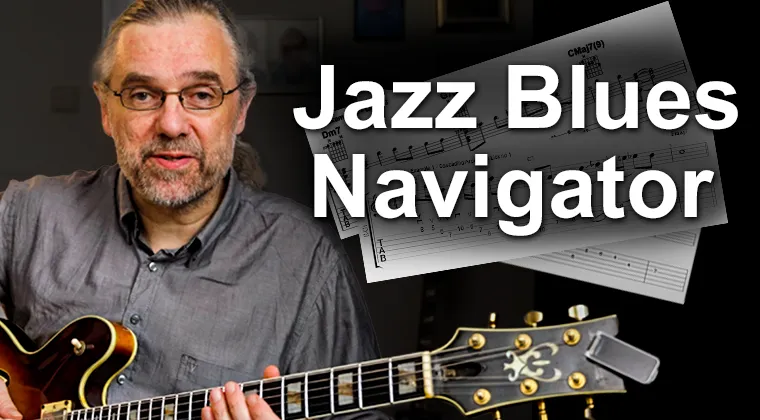
About this course
152 lessons
3.5 hours of video content
Start Your Jazz Blues Journey!
Learn Jazz Blues in 10 weeks with a method that develops your actual playing.
$99
Regular price – one-time payment
Lifetime access
3 × $39
3 monthly payments of $39
Hi, I'm Jens Larsen
This is how I can help you with jazz chords and comping

I started playing Jazz when I was 22 years old. At the time, I discovered how much fun playing and improvising Jazz was.
A few years later, I was studying at the Royal Conservatory in The Hague and got my degree to become a professional Jazz guitarist. I have now performed 1000s of concerts on 4 continents and recorded several albums.
Because I learned most of what I know in my twenties, I had to be very efficient with learning and I was always interested in both being able to play and being able to understand what I was practicing.
This proved to be a huge advantage in teaching students and later also in making YouTube Lessons on Jazz Guitar.
It has always been my mission to figure out exactly what students need to learn and how they learn it in an efficient way. This is probably why my YouTube channel is such a huge success. Something that I am very grateful for and that has put me in touch with so many people who, like me, love Jazz and love learning and playing Jazz.
One of the topics that I remember always asking my teachers about and never getting any really good answers was comping, and I have researched the method in this course for a long time.
This course takes a different approach than what is taught in most other places, but it has worked amazingly well for my students. I am very proud to show you this extensive method, which combines my experience as a student and as a teacher.
Jens Larsen
© Copyright Jens Larsen - Jazz Guitar 2026
By purchasing from Jens Larsen - Jazz Guitar, you agree to Jens Terms of Use & Privacy Policy.